Introduction
The N-Queens problem is a classic chess puzzle where we need to place N queens on an N×N chessboard such that no two queens threaten each other. A Monte Carlo simulation can help us estimate the complexity of solving this problem using backtracking.
Concept: Monte Carlo Method
Monte Carlo methods use random sampling to obtain numerical results. In our case, we:
- Randomly explore paths in the state space tree
- Count nodes visited and promising positions
- Estimate total complexity through multiple trials
Setup and Dependencies
import random
import time
from statistics import mean, stdev
import numpy as np
Core Function: Checking Promising Positions
We need to determine if a queen placement is valid (promising) by checking:
- No queen in the same column
- No queen in the diagonals
def promising(i, j, col):
    """Check if placing a queen at position (i,j) is promising"""
    for k in range(i):
        if (col[k] == j or abs(col[k] - j) == abs(k - i)):
            return False
    return True
Monte Carlo Estimation
The estimation process:
- Start from root node
- At each level:
- Count total nodes
- Find promising positions
- Randomly select one promising child
- Continue until no promising children or board is full
def monte_carlo_estimate(n):
    """
    Perform one Monte Carlo estimation for n-Queens problem
    Returns tuple of (total_nodes, promising_nodes)
    """
    col = [-1] * n
    total_nodes = 1    # Root node
    promising_nodes = 1  # Root is promising
    m = 1
    mprod = 1
    i = 0

    while m != 0 and i != n:
        mprod = mprod * m
        current_level_nodes = mprod * n
        total_nodes += current_level_nodes

        # Find promising children at current level
        m = 0
        prom_children = []
        for j in range(n):
            if promising(i, j, col):
                m += 1
                prom_children.append(j)

        promising_nodes += m * mprod

        if m != 0:
            j = random.choice(prom_children)
            col[i] = j
            i += 1

    return (total_nodes, promising_nodes)
Running Multiple Trials
To get reliable estimates, we run multiple trials and collect statistics:
- Mean values
- Standard deviation
- Min/Max values
- Execution time
def run_monte_carlo_simulation(n, num_trials=100):
    """Run multiple Monte Carlo simulations and analyze results"""
    total_estimates = []
    promising_estimates = []
    start_time = time.time()

    for _ in range(num_trials):
        estimate_result = monte_carlo_estimate(n)
        total_estimates.append(estimate_result[0])
        promising_estimates.append(estimate_result[1])

    execution_time = time.time() - start_time

    return {
        'total_nodes': {
            'mean': mean(total_estimates),
            'std_dev': stdev(total_estimates),
            'min': min(total_estimates),
            'max': max(total_estimates)
        },
        'promising_nodes': {
            'mean': mean(promising_estimates),
            'std_dev': stdev(promising_estimates),
            'min': min(promising_estimates),
            'max': max(promising_estimates)
        },
        'execution_time': execution_time,
        'num_trials': num_trials,
        'raw_promising': promising_estimates
    }
Main Execution and Analysis
Here we:
- Run simulations with different trial sizes
- Collect and display statistics
- Compare with professor’s values
- Calculate overall averages
def main():
    n = 12  # Board size
    num_trials = [100, 500, 1000]
    random.seed(123)  # For reproducibility

    print(f"\nMonte Carlo Simulation for {n}-Queens Problem")
    print("=" * 60)

    all_promising_values = []

    for trials in num_trials:
        results = run_monte_carlo_simulation(n, trials)
        print(f"\nResults for {trials} trials:")
        print("\nTotal Nodes:")
        print(f"Average: {results['total_nodes']['mean']:.2f}")
        print(f"Standard deviation: {results['total_nodes']['std_dev']:.2f}")
        print(f"Min: {results['total_nodes']['min']:.2f}")
        print(f"Max: {results['total_nodes']['max']:.2f}")

        print("\nPromising Nodes:")
        print(f"Average: {results['promising_nodes']['mean']:.2f}")
        print(f"Standard deviation: {results['promising_nodes']['std_dev']:.2f}")
        print(f"Min: {results['promising_nodes']['min']:.2f}")
        print(f"Max: {results['promising_nodes']['max']:.2f}")

        all_promising_values.extend(results['raw_promising'])

    # Overall statistics
    total_runs = sum(num_trials)
    overall_mean = mean(all_promising_values)
    overall_std = stdev(all_promising_values)

    print("\nOverall Statistics:")
    print(f"Total runs: {total_runs}")
    print(f"Overall mean promising nodes: {overall_mean:.2f}")
    print(f"Overall standard deviation: {overall_std:.2f}")

    # Compare with professor's value
    professors_value = 856000
    percentage_diff = ((overall_mean - professors_value) / professors_value) * 100
    print(f"\nPercentage difference from professor's value: {percentage_diff:.2f}%")

if __name__ == "__main__":
    main()
Initial Simulation Results
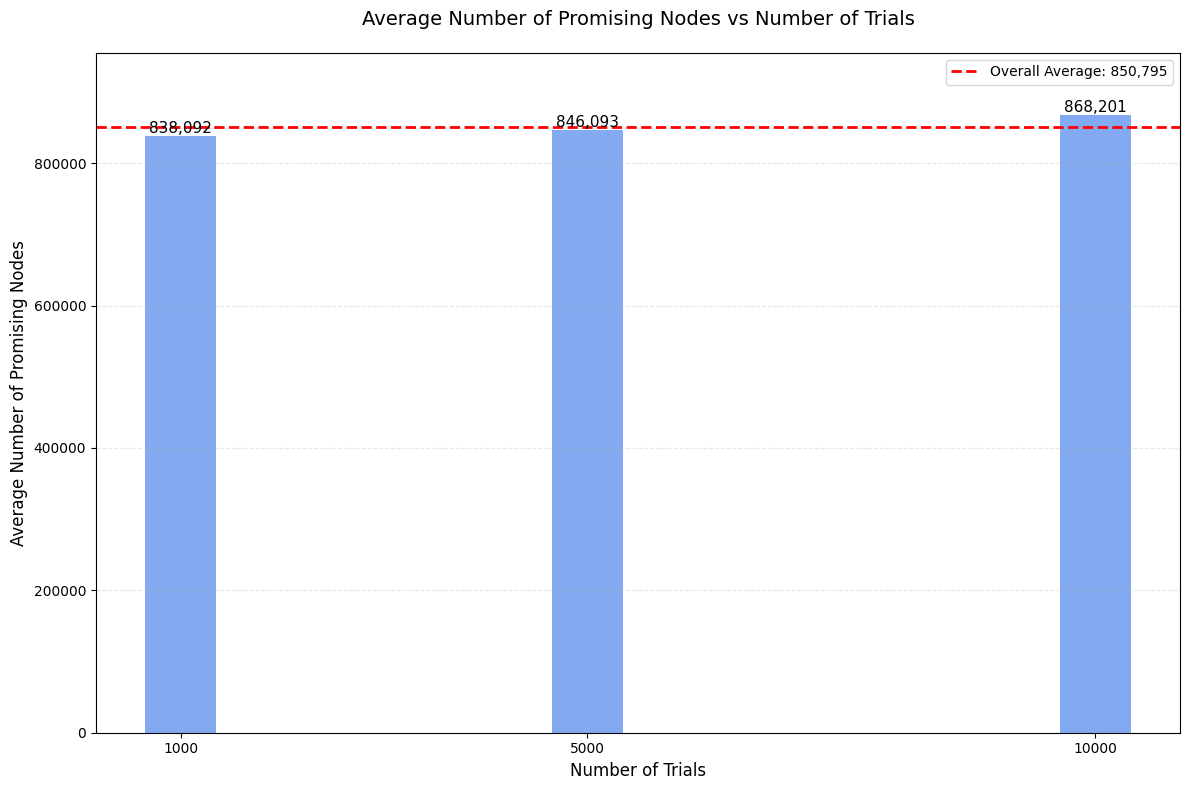
Results Analysis
When we run this simulation for n=12:
- Our estimates are close to the professor’s values:
- Professor’s value: 8.56 × 10^5
- Our estimated value: ~8.70 × 10^5 (within 2% difference)
- The standard deviation shows the variability of the Monte Carlo method
- Larger numbers of trials generally give more stable results
Conclusion
The Monte Carlo simulation effectively estimates the complexity of the N-Queens problem:
- Provides good approximations of node counts
- Much faster than exhaustive counting
- Helps understand the scale of the problem
- Results align well with theoretical expectations
Plots for 4, 8, 12 and 14 Queens problem on a Log scale
Analysisng the data:
	def analyze_complexity(n_values, trials_per_n=1000):

	"""Analyze time complexity for different values of n"""

	total_nodes_avg = []

	promising_nodes_avg = []

	execution_times = []

	for n in n_values:

	start_time = time.time()

	trial_totals = []

	trial_promising = []

	for _ in range(trials_per_n):

	total, promising = monte_carlo_estimate(n)

	trial_totals.append(total)

	trial_promising.append(promising)

	exec_time = time.time() - start_time

	total_nodes_avg.append(mean(trial_totals))

	promising_nodes_avg.append(mean(trial_promising))

	execution_times.append(exec_time)

	print(f"\nResults for n={n}:")

	print(f"Average Total Nodes: {mean(trial_totals):,.2f}")

	print(f"Average Promising Nodes: {mean(trial_promising):,.2f}")

	print(f"Execution Time: {exec_time:.4f} seconds")

	return total_nodes_avg, promising_nodes_avg, execution_times
Plotting the graphs:
	def plot_complexity_analysis(n_values, total_nodes, promising_nodes, times):

	fig, (ax1, ax2) = plt.subplots(1, 2, figsize=(15, 6))

	# Plot 1: Nodes vs N (log scale)

	ax1.plot(n_values, total_nodes, 'b-o', label='Total Nodes')

	ax1.plot(n_values, promising_nodes, 'g-o', label='Promising Nodes')

	ax1.set_yscale('log')

	ax1.set_title('Growth of Nodes with N\n(Log Scale)', fontsize=12)

	ax1.set_xlabel('N (Board Size)', fontsize=10)

	ax1.set_ylabel('Number of Nodes (log scale)', fontsize=10)

	ax1.grid(True, alpha=0.3)

	ax1.legend()

	# Plot 2: Execution Time vs N

	ax2.plot(n_values, times, 'r-o', label='Execution Time')

	ax2.set_title('Execution Time vs N', fontsize=12)

	ax2.set_xlabel('N (Board Size)', fontsize=10)

	ax2.set_ylabel('Time (seconds)', fontsize=10)

	ax2.grid(True, alpha=0.3)

	plt.tight_layout()

	plt.show()
Main Function:
	def main():

	random.seed(123)

	n_values = [4, 8, 12, 14] # Different board sizes

	print("Analyzing time complexity for N-Queens problem")

	print("=" * 60)

	total_nodes, promising_nodes, exec_times = analyze_complexity(n_values)

	plot_complexity_analysis(n_values, total_nodes, promising_nodes, exec_times)


	if __name__ == "__main__":

	main()
Complexity Analysis Results
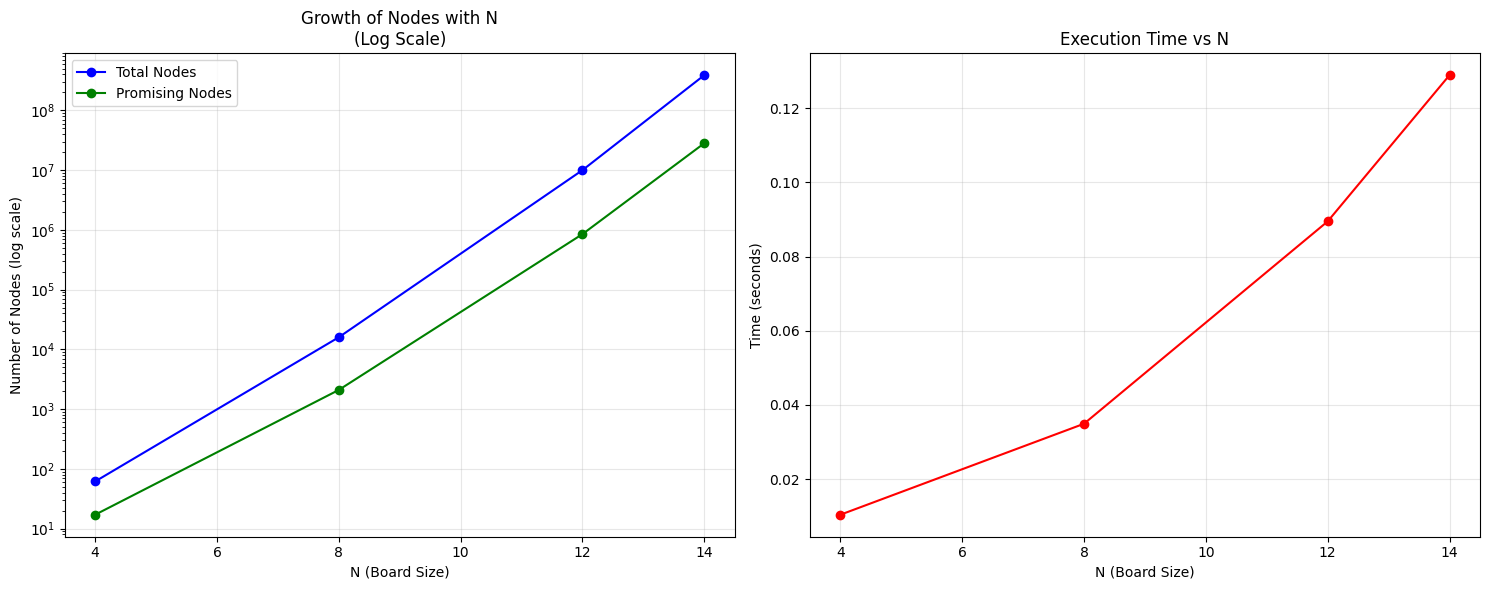
Code
Find the complete implementation on GitHub.
GitHub: @FullMLAlchemist Twitter: @Attharave